Author: Robert Barbere (A Constantly Racing Mind)
Rating: 4 / 5
What happens when an actor loses his face, his career, his reputation, and eventually his humanity? In DC’s Clayface, the answer involves experimental nanotechnology, agonizing body horror, and a man who devolves from a rising Hollywood star into something barely human.
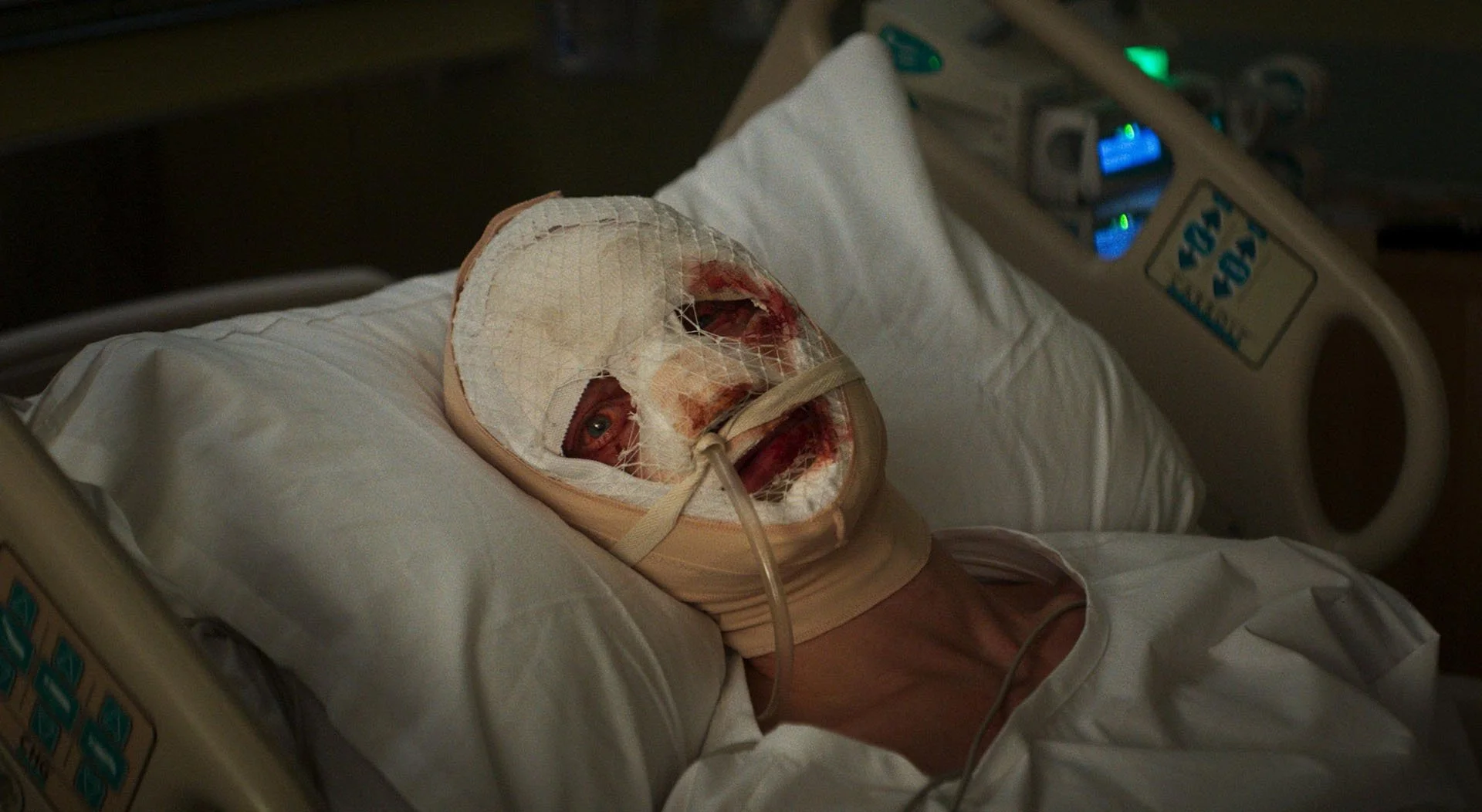
Taking a staple Batman adversary and dropping him into an R-rated, Cronenbergian psychological horror landscape is an audacious direction for comic-book cinema. Comic book adaptations have experimented with nearly every tonal variation imaginable, but treating Matt Hagen’s condition as an organic, grotesque tragedy rather than a sanitized supervillain origin is a setup that immediately commands attention.
Clayface works because it refuses to conform to the standard comic-book sandbox. It is a focused, tragic character study exploring a man whose physical and emotional identity is liquefying before his eyes, where the very miracle offering to resurrect his life serves as the catalyst that obliterates it.
Part I: Non-Spoiler Review
The Premise: Tragedy Over Spectacle
The narrative follows Matt Hagen (Tom Rhys Harries), a promising young actor on the ascent in Hollywood. His career and personal life are systematically erased after a vicious attack leaves him severely disfigured. In an industry driven entirely by aesthetics, losing his face strips away his livelihood, alienates his social circle, and relegates him to the fringes of society in Gotham's Narrows.

Desperate to resurrect his career, Hagen turns to an experimental medical procedure pioneered by Dr. Caitlyn Core (Naomi Ackie). Her breakthrough involves unstable medical nanotechnology engineered to regenerate severe tissue damage. While the treatment initially repairs his ruined features, the cellular stability of the nanites is inextricably linked to Hagen’s emotional equilibrium. When panic, anxiety, or rage flare, his flesh destabilizes—initiating a gruesome cycle where his terror of losing his face accelerates its physical breakdown.

The thematic DNA here draws obvious, welcome parallels to David Cronenberg’s The Fly, where biological degeneration runs parallel to psychological decay. Traces of Sam Raimi’s Darkman echo through Hagen's desperate quest for identity reconstruction, while recent body-horror commentary like The Substance mirrors the script’s obsession with vanity and career validation. Longtime fans will also recognize heavy narrative ties to Batman: The Animated Series, which famously retooled Hagen as an actor hooked on a transformative chemical compound. Here, screenwriters Mike Flanagan and Hossein Amini translate that heartbreaking animated origin into an adult, visceral horror framework.
Behind the Camera: The Craft of Physical Degradation
Director James Watkins (Eden Lake, Speak No Evil) is well versed in orchestrating claustrophobic psychological dread. In Clayface, Watkins focuses that tension inward, making Hagen's own flesh the hostile environment. The script from Mike Flanagan (Midnight Mass, The Haunting of Hill House) and Hossein Amini (Drive) strikes a fine balance between intimate personal grief and sudden, unsparing brutality.

Rob Hardy’s cinematography provides the tangible grounding essential for body horror. Having previously photographed Ex Machina and Annihilation, Hardy captures anatomical mutilation with chilling clarity, ensuring that Hagen's transformation feels uncomfortably real rather than like glossy, weightless CGI. Jon Harris’s editing controls the film’s 108-minute runtime with surgical precision, holding shots of bodily trauma long enough to make the audience squirm before cutting cleanly into the wider psychological aftermath.
Volker Bertelmann’s musical score avoids theatrical bombast in favor of unnerving, textural tension that underscores Hagen’s loss of somatic control. Notably, the production places its needle drops over quiet, contemplative scenes rather than blasting pop tracks during action set pieces—a refreshing reversal of contemporary superhero cliches.
Performances and Character Shortcomings
Tom Rhys Harries delivers a tour-de-force central performance. Hagen is a demanding part requiring an actor to convincingly play vanity, physical ruin, weeping vulnerability, and terrifying menace. Harries ensures Hagen remains compelling even as his actions cross into the unforgivable, proving that a protagonist can be tragic without remaining sympathetic.

Naomi Ackie brings warmth, scientific intelligence, and emotional presence to Dr. Caitlyn Core, serving as the moral tether to Hagen's descent.

Unfortunately, the broader supporting cast is where the screenplay falters. The romantic triangle forced between Hagen, Caitlyn, and her detective fiancé Jon Belli (Max Minghella) feels underwritten and lacks genuine chemistry. Gotham's systemic corruption and police dynamics feel surface-level, lacking the gritty texture seen in projects like The Batman or The Penguin.
Furthermore, David Dencik’s mob boss Marco Zabo suffers from thin writing, spouting generic villain monologues about Hagen’s father that belong in a lesser comic-book picture. Peripheral figures like Hagen's manager Frank and his Hollywood friend Cory Bowery function purely as utilitarian plot markers to be checked off during the revenge arc rather than fully dimensional characters.
Non-Spoiler Verdict & Box Office Context
Operating on a modest reported production budget of $40–$44 million, Clayface pulled in an impressive $24 million domestic opening ($46.5 million worldwide), demonstrating clear audience appetite for mid-budget, R-rated character horror free from standard franchise baggage.

The film has pacing stumbles and shallow supporting writing, but its emotional core and terrifying physical effects make it an engaging horror tragedy. It is a solid, focused genre piece that proves DC's rogues can flourish when unshackled from traditional formula. (Note: The film contains zero mid- or post-credit scenes, allowing its closing beat to stand entirely on its own merits).

SPOILER WARNING: FULL PLOT & ENDING ANALYSIS AHEAD
The following section contains full spoilers for the plot, character deaths, creature effects, and concluding twists of Clayface.
Part II: The Metaphysical Breakdown & Anatomy of a Monster
1. Mutilation, Nanites, and Emotional Instability
Hagen’s downward spiral begins with his entanglement with Mia Torres (Joana Ribeiro), a woman tied to crime boss Marco Zabo. When Zabo discovers the affair, he restrains Hagen and brutally carves his face to ribbons. To insulate himself, Zabo leverages his influence while Mia publicly frames Hagen as her abuser, annihilating Hagen's public image alongside his physical features.
When Hagen undergoes Dr. Core’s experimental nanotechnology treatment, the cellular repairs initially look miraculous. However, the nanites react dynamically to neurochemistry. High cortisol levels, panic, and rage disrupt the cellular bonds, causing his epidermis to liquefy.

Having undergone surgical procedures myself, watching scalpel incisions and needles plunge into raw facial tissue was genuinely stomach-churning. The airplane bathroom sequence stands as the most agonizing set piece in the film: trapped during heavy turbulence, Hagen’s facial structure breaks down in real time, forcing him to take a pair of nail scissors and snip through strings of melted, fused flesh just to clear his obstructed eyelids.

2. The Overdose and the Seduction of Revenge
Driven mad by his inability to stabilize his appearance, Hagen injects a lethal surplus of the nanite fluid directly into his system. The overdose rewrites his entire cellular biology, granting him fluid shapeshifting, vocal mimicry, rapid healing, and the terrifying ability to weaponize his malleable mass.
With unlimited malleability comes total moral collapse. Hagen embarks on a calculated purge against those who abandoned him. He murders his manager Frank, and suffocates his former friend Cory Bowery.
The assault on Zabo’s nightclub escalates the body horror to nightmarish heights. Hagen uses his liquefied clay mass to force fluid down Mia’s throat, suffocating her from the inside out. During the melee, faces press into backs, hands yank out spinal columns, and an adversary bites Hagen's flesh only to choke on the living mud. Hagen’s vengeance culminates when he sprays his own acidic, nanite-infused blood directly onto Zabo’s face, melting the mobster's features into an unrecognizable paste—a poetic, horrifying mirror of his own mutilation.
3. Identity Theft and the Climax
Hagen’s moral deterioration peaks in his dynamic with Caitlyn. Unable to cope with the reality that she loves someone else, Hagen murders Detective Jon Belli and assumes his physical identity, sleeping in his bed and taking his life. The actor who lost his identity has graduated from reclaiming his old persona to actively stealing another man’s existence.
When Caitlyn discovers Belli's corpse, the confrontation breaks Hagen's fractured mind. The emotional overload destabilizes the nanites completely, transforming him into a massive, lumbering mud aberration. While the practical makeup and in-camera actor swaps throughout the film are masterfully executed, this final "blob-man" creature design feels like an awkward aesthetic compromise between a recognizable human face and a traditional comic-book mud monster.

In a brief flash of returning sanity, Hagen begs Caitlyn to stop him. She triggers the failsafe protocol, causing his liquefied mass to collapse and wash away into the Gotham sewer system.
4. The Tragic Irony of the Final Twist
In the closing scene, Caitlyn drops spare change into the cup of a destitute man on the street. Moments later, the man slips into a storm drain and shifts back into Matt Hagen.
The survival is not triumphant; it is an eternal prison sentence. Hagen can imitate any face on Earth, but he can never again inhabit his own. His shapeshifting power is his ultimate punishment—a permanent mask worn by a man who has lost his original self forever. By keeping the narrative contained and leaving Batman entirely out of the equation, the film preserves Matt Hagen’s tragedy as a self-inflicted, devastating horror story.
