The Big Blue Milestone: February 10, 1996
In 1996, Deep Blue was like a fast but predictable engine. By 1997, it had been upgraded to "Deeper Blue," and Kasparov famously felt it had developed "creative" intuition, which he later realized was just the machine's deeper search. He had discovered a bug in his own psychological defense.
Garry Kimovich Kasparov (born Garik Kimovich Weinstein on 13 April 1963).
is a Russian chess grandmaster, political activist and writer, who was the World Chess Champion from 1985 to 2000. His peak FIDE chess rating of 2851,[2] achieved in 1999, was the highest recorded until being surpassed by Magnus Carlsen in 2013. From 1984 until his retirement from regular competitive chess in 2005, Kasparov was ranked the world's No. 1 player for a record 255 months overall. Kasparov also holds records for the most consecutive professional tournament victories (15) and Chess Oscars. (Wikipedia)
Mission Log: The Deep Blue War (1996–1997)
| Milestone | Date | Result / Impact |
|---|---|---|
| The First Crack | Feb 10, 1996 | Game 1: Deep Blue wins. The first computer victory over a champion in tournament play. |
| Human Dominance | Feb 17, 1996 | Kasparov adapts and wins the overall match 4–2, proving human intuition still held the edge. |
| The Rematch | May 3–11, 1997 | A highly controversial 6-game series. The machine system is heavily upgraded to "Deeper Blue." |
| Final Defeat | May 11, 1997 | Kasparov resigns Game 6. Deep Blue wins the match 3.5–2.5. The "Biological Wall" falls. |
The Technical Shift: This was a "Brute Force" system. Deep Blue didn't "think" like a human; it processed 200 million positions per second. It was a victory of sheer engineering scale over biological genius.
The Psychological Impact: Kasparov famously felt like he was playing against a "god-like" intelligence because the machine made moves that seemed "human" or "creative," when in reality, it was just the first time a machine's racing mind was faster than his own.
System Profile: IBM Deep Blue (1996)
| Hardware Specification | Technical Data |
|---|---|
| Architecture | RS/6000 SP Massively Parallel System; 30-node supercomputer. |
| Processing Velocity | 200,000,000 chess positions evaluated per second. |
| Dedicated Logic | 480 custom VLSI chess chips working in parallel "brute force" synchronicity. |
| Historic Milestone | Feb 10, 1996: First machine to defeat a world champion under tournament conditions. |
To understand the journey from Deep Blue to the AI we use today, we have to view it as a shift from "Brute Force Calculation" to "Neural Pattern Recognition." It is a transition from a machine that follows a long list of instructions to one that "learns" from data.
The Evolution of the Artificial Mind: From 1996 to Now
1. Deep Blue (1996): The Brute Force Era
Deep Blue was essentially a massive, high-speed filing cabinet. It didn't "understand" chess; it possessed a "Search Tree" that was deeper and faster than any human's.
The Logic: If-Then-Else. "If the opponent moves X, then I evaluate 200 million versions of Y."
The Limitation: It was a Specialized System. Deep Blue could beat Kasparov at chess, but it couldn't tell the difference between a picture of a cat and a picture of a dog. It had zero flexibility.
2. Watson (2011): The Natural Language Shift
Fifteen years later, IBM’s Watson moved the goalposts by competing on Jeopardy!.
The Breakthrough: This wasn't just math; it was Natural Language Processing (NLP). Watson had to understand puns, slang, and riddles.
The Technical Leap: It used "Unstructured Data." It didn't have a pre-written move list; it had to search 200 million pages of content and find the most likely answer in three seconds. We moved from "Calculation" to "Probability."
3. AlphaGo (2016): The Intuition Engine
When Google’s DeepMind created AlphaGo, they tackled the game of Go—a game with more possible moves than there are atoms in the observable universe. Brute force was impossible.
The breakthrough: Neural Networks. AlphaGo didn't just calculate; it "watched" millions of games and played against itself to "learn" what a winning position looked like.
The "ACRM" Hook: In Game 2, Move 37, AlphaGo made a move so creative that human masters thought it was a mistake. It wasn't a calculation; it was the machine's version of intuition.
4. Generative AI (The 2020s): The Predictive Architecture
Today’s Large Language Models (LLMs) represent a complete departure from the Deep Blue model.
The Transformer Architecture: Instead of processing one piece of data at a time, modern AI looks at the context of the entire system simultaneously.
Predictive Logic: It doesn't "know" facts the way Deep Blue did. It predicts the most logical next "token" (word or pixel) based on the trillions of patterns it has seen.
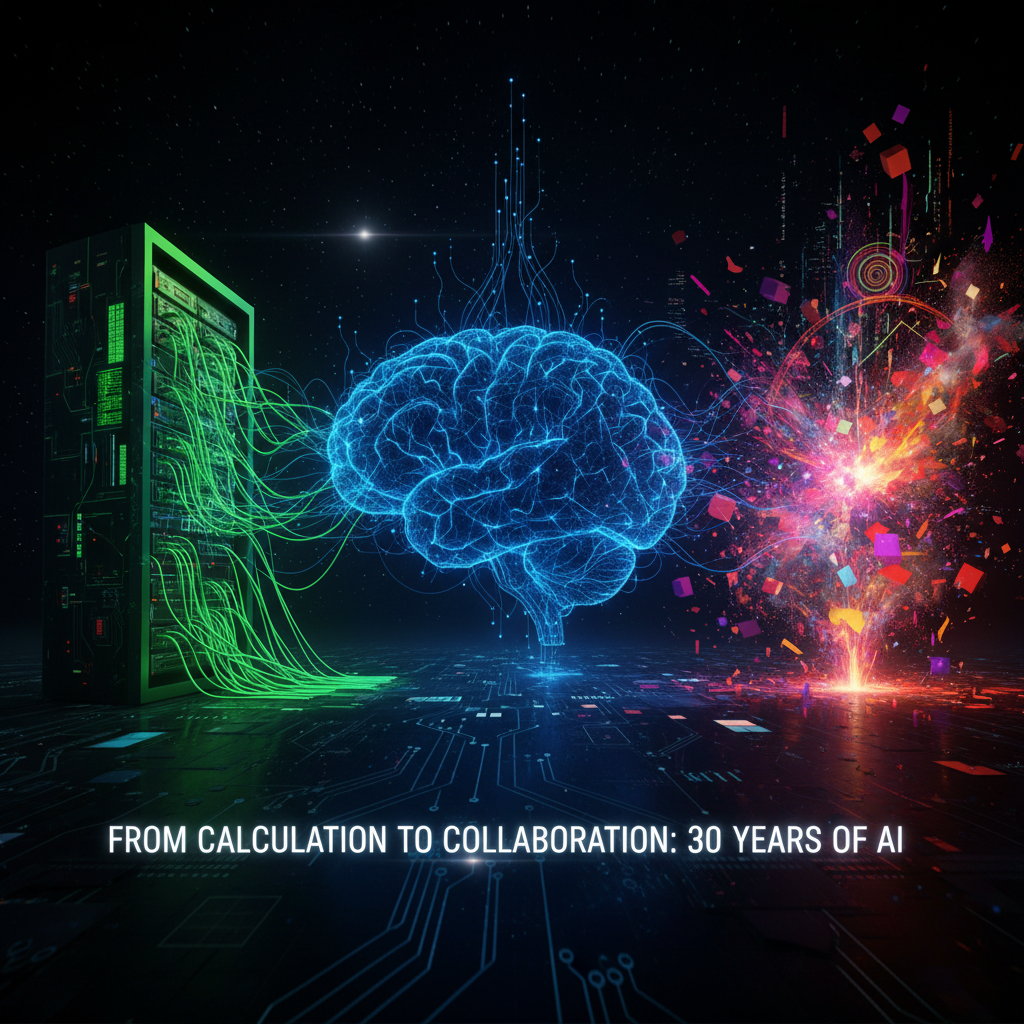
Technical Comparison: Logic vs. Learning
| Feature | Deep Blue (1996) | Generative AI (2026) |
|---|---|---|
| Operational Goal | Solve a closed mathematical system (Chess). | Simulate human creativity and reasoning. |
| Thinking Style | Deductive: Follows rigid, pre-programmed rules. | Inductive: Infers rules from massive data patterns. |
| Hardware Focus | Custom VLSI Chess Chips (Specialized). | Massive GPU/TPU Clusters (Parallel Processing). |
| System State | A static, perfect "Search Tree" calculator. | An adaptive, evolving Neural Network. |
The 1996 "Wall of Resistance"
In 1996, Kasparov was the undisputed King of Chess. When he faced Deep Blue, he wasn't just playing for himself; he felt he was defending the entire human race's intellectual superiority.
The "Racing Mind" Shock: After losing his first game, Kasparov became obsessed with the "system" of the machine. He famously accused the IBM team of human intervention because he couldn't accept that a machine could make a move that felt so "deeply human."
The Shift: From Competitor to Collaborator
After the 1997 rematch (which he lost), Kasparov’s mind didn't stop racing—it pivoted. He realized that the future wasn't Man vs. Machine, but Man + Machine.
Advanced Chess: He pioneered "Cyborg Chess" (Advanced Chess), where a human and a computer work together as a single system.
The Result: He discovered that a "weak" human player plus an "average" machine could beat the strongest supercomputer or the strongest human alone. It was about the system of cooperation.
The 2026 Perspective
Today, Kasparov views AI not as a threat but as an "augmentation." He argues that machines give us the freedom to focus on creativity, strategy, and vision, while they handle the brute force calculation.
Personnel File: Garry Kasparov
| 1996 Role | World Chess Champion; The "Biological Wall" against silicon logic. |
| Technical Realization | Human intuition is a pattern-matching system; Machine logic is a search system. Combining them creates a superior "Centaur" model. |
| Current Philosophy | AI as an "Externalized Intelligence" that frees the human mind from drudgery. |
| Key Quote | "Machines have calculations. We have understanding. Machines have instructions. We have purpose." |
