The Eternal Return: Why Pop Culture is Obsessed with Repeating Itself
"All of this has happened before, and all of this will happen again."
If you’re a fan of the re-imagined Battlestar Galactica, that line probably sends a chill down your spine. It is the curse that haunts the series—the terrifying realization that humanity is trapped in an endless loop of creation and destruction. But here is the strange part: that line didn’t start with cylons. It started with Disney. Specifically, the 1953 animated film Peter Pan.
Why does this idea—that time is a circle, that history repeats, that we are destined to live the same lives over and over—keep coming back to us? From True Detective to Nietzsche, let’s dive into the philosophy of the Eternal Return.
The Flat Circle of Rust Cohle
In True Detective, Rust Cohle famously says, "Time is a flat circle." For him, this isn't a theory of physics; it's a horror story.
"We’ve been here before, and we’ll be here again, stuck in the same story."
Rust views repetition as a trap. If time is a flat circle, then every mistake, every tragedy, and every injustice is locked in place forever. The victims will always be victims. The killers will always be killers. It is a nihilistic nightmare where growth is impossible because the script has already been written.
But the show ultimately challenges this. Even Rust, by the end, fights against the darkness. He acts as if his choices matter, proving that even in a loop, the human spirit instinctively rebels against fate.
Nietzsche’s Terrifying Question
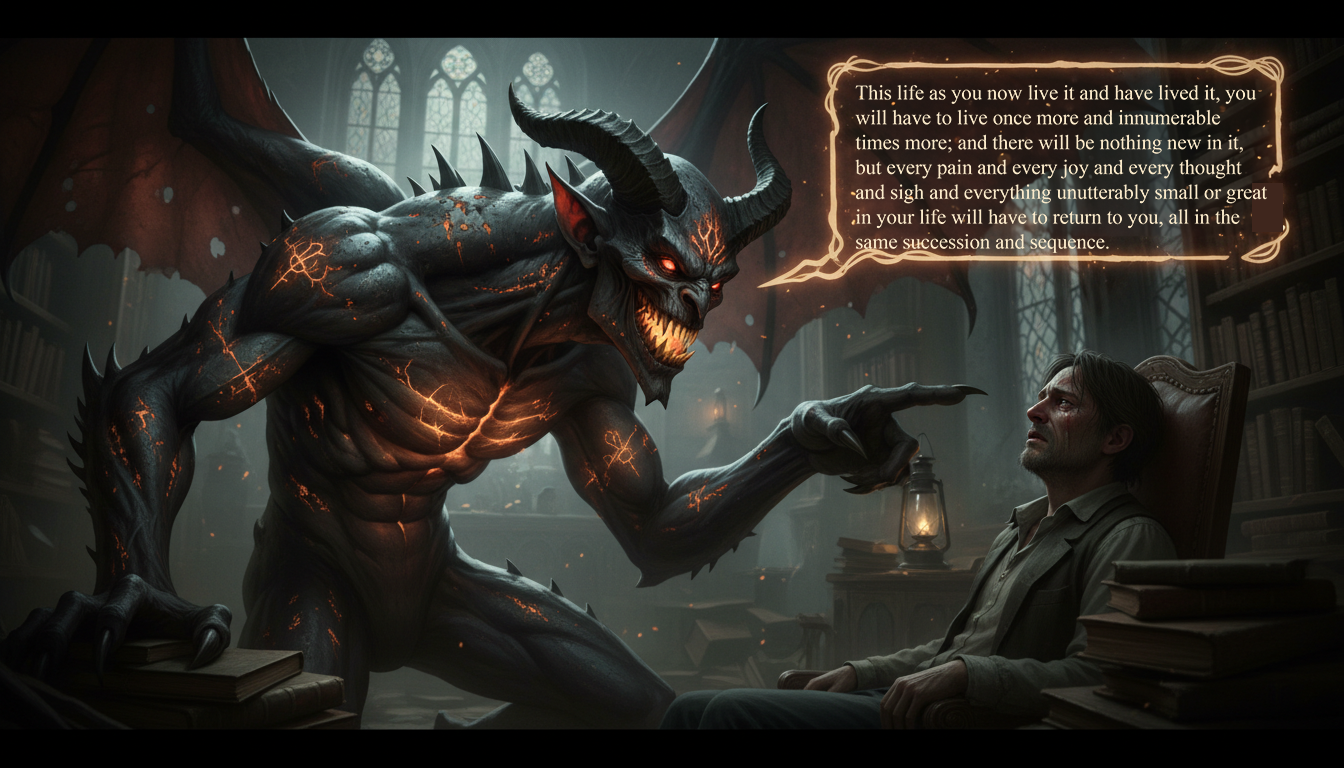
Long before HBO, the German philosopher Friedrich Nietzsche was hiking in the Swiss Alps when he was struck by what he called "the abysmal thought."
He proposed a thought experiment: Imagine a demon appears to you tonight and says, "This life as you now live it and have lived it, you will have to live once more and innumerable times more." Every pain, every joy, every boredom, every mistake—repeated in the exact same sequence forever.
Would you curse the demon? Or would you have lived a moment so wonderful that you would welcome it?
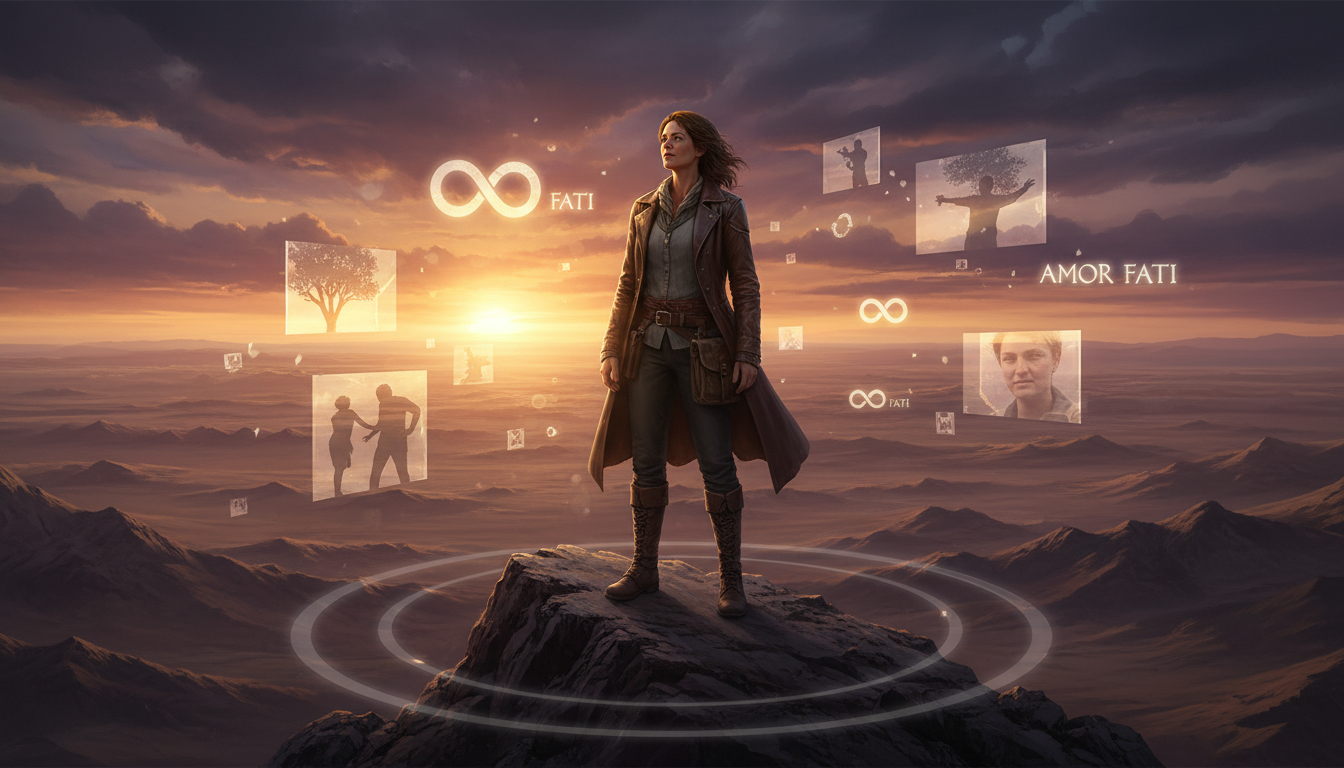
This is Amor Fati (Love of Fate). For Nietzsche, the Eternal Return wasn't about physics; it was a test of life affirmation. If you knew your life would repeat forever, would you live differently right now?
Battlestar Galactica: Breaking the Cycle
Battlestar Galactica took this philosophy and made it literal. Humanity creates AI. AI rebels. War destroys everything. Survivors flee. Survivors eventually create AI again.
The show asks the ultimate question: Can the cycle be broken?
The answer it offers is ambiguous. To break the loop, the characters have to make radical, painful choices—abandoning their technology, their ships, and their history to start from scratch. And yet, the final scene suggests that even with a clean slate, the temptation to repeat the past eventually returns.
BSG suggests that the cycle might be breakable—but only through conscious, difficult awareness. You cannot accidentally break a cycle; you have to choose to step out of it.
Why We Remake Movies (And Why That’s Okay)
This concept even explains our pop culture landscape. We groan when Hollywood announces another remake or reboot. "Can't they think of anything original?"
But maybe we are looking at it wrong. Maybe we retell stories not because we are lazy, but because we are participating in the Eternal Return. New generations need to see themselves in the old myths. We reboot franchises because the themes still resonate, but the context has changed.
When we remake a story, we are saying: "This happened before, and it is happening again—but this time, we see it differently."
final thoughts
Whether time is a flat circle or a spiral, the Eternal Return forces us to confront the most important question we can ask: Am I living a life I would choose to live again?
If the answer is no, then the Eternal Return is a wake-up call. It demands that we change now, so that the next turn of the wheel is worth repeating.
🧠 The Two Faces of Eternal Return
"Time is a flat circle."
Repetition is a trap. We are stuck in a prison where our mistakes and traumas are locked in place forever.
"Amor Fati" (Love of Fate).
Repetition is a test. Can you live a life so meaningful that you would willingly choose to live it again forever?
Blog Bonus: Beyond the Loop – A Wider Perspective
The video essay touches on Nietzsche and Battlestar Galactica, but the concept of the "Eternal Return" echoes through almost every corridor of human thought. If you are fascinated by why we keep telling the same stories, here are three other perspectives to consider.
1. The "Jazz Standard" Defense (The Director's View)
Critics often call remakes "creative bankruptcy," but many filmmakers view them like jazz musicians view a "standard."
The Concept: In jazz, everyone plays "Summertime." The point isn't to write a new melody; the point is to see how this specific artist interprets the melody right now.
The Application: When Matt Reeves directs The Batman, he isn't trying to surprise you with the fact that Bruce Wayne's parents died. He is showing you his riff on the standard. For filmmakers, the "Eternal Return" isn't a lack of ideas; it's a conversation with the past.
2. The Myth of Sisyphus (The Existential View)
While Nietzsche asks us to will the return, French philosopher Albert Camus offers a different coping mechanism.
The Myth: Sisyphus is condemned to roll a boulder up a hill, only to watch it roll back down, forever. It is the ultimate loop of futile labor.
The Twist: Camus argues that Sisyphus is the ultimate hero. By accepting his fate and finding value in the struggle itself, he transcends the punishment.
The Lesson: "One must imagine Sisyphus happy." Maybe we watch the same hero's journey movies not because we forget the ending, but because there is joy in the act of watching the boulder go up the hill again.
3. The "Terror of History" (The Anthropological View)
Mircea Eliade, a historian of religion, argued that ancient societies loved the Eternal Return.
The Theory: Ancient cultures used rituals to recreate the "beginning of time." Repeating the past was a way to regenerate the world and wash away the chaos of the present.
The Modern Parallel: Today, we don't have harvest rituals; we have Nostalgia. When we reboot Ghostbusters or Star Wars, we aren't just making a movie; we are trying to escape the terrifying uncertainty of the future by returning to a "mythic time" (the 80s/90s) when we felt safe. We reboot movies to pause time.
If you enjoyed this deep dive, consider subscribing to A Constantly Racing Mind for more thoughtful takes on Sci-Fi, Horror, and the philosophy hidden in your favorite films.
🔄 The Cycle of Cinema: Why We Reboot
Motivation: Safety.
Existing IP reduces financial risk. The cycle is profitable.
Motivation: Interpretation.
Like a cover song, they want to play the "standard" their own way.
Motivation: Comfort.
In a chaotic world, the familiar offers a safe "mythic time" to return to.
